
Walk into any outdoor retailer, and you’ll see two very different kinds of camping gear sitting side by side.
There’s the basic kit, the affordable dome tent, the synthetic sleeping bag, and the single-burner stove that gets the job done.
Table of Contents
And then there’s the other stuff: ultralight shelters made from materials that cost more per gram than steak, sleeping bags rated to temperatures that would shut down a city, and packs engineered with suspension systems that could outlast the trail itself.
That second category is what the outdoor industry calls technical camping gear. But what does the word ‘technical’ actually mean? Who needs it? And most importantly, is it worth the price tag?
This guide answers all of that. Whether you’re gearing up for your first backcountry trip or trying to figure out whether to upgrade your kit, here’s everything you need to know.
What makes camping gear ‘technical’?
The word ‘technical’ in the outdoor industry doesn’t have a strict industry-wide definition, but it consistently refers to gear that is purpose-engineered for demanding conditions, performance-critical situations, or weight-conscious applications where standard gear would fail or fall short.
Technical gear is built around specific tradeoffs that matter in the backcountry: weight versus warmth, packability versus durability, and breathability versus waterproofing.
Manufacturers invest heavily in materials science, ergonomic design, and field testing to push those tradeoffs further than off-the-shelf camping gear ever could.
Quick definition: Technical camping gear is equipment designed and tested to perform under demanding outdoor conditions, extreme weather, extended trips, remote terrain, or load-critical applications where standard gear would be inadequate.
Technical vs. regular camping gear: the key differences
The difference between technical and regular camping gear isn’t just price it’s a fundamental shift in design priorities.
Here’s how they compare across the dimensions that matter most:
| Feature | Regular camping gear | Technical camping gear |
| Weight | Heavier comfort is prioritized. | Ultralight to lightweight grams count |
| Materials | Standard nylon, polyester, foam | Dyneema, silnylon, 850-fill down, Pertex |
| Weather rating | 3-season at best | 4-season, alpine, extreme cold capable |
| Packability | Moderate bulkier when packed | Compresses small, designed for tight packs |
| Durability | Consumer-grade | Field-tested, built to last years of hard use |
| Price | Budget to mid-range | Mid-range to premium |
| Best for | Car camping, campgrounds, mild conditions | Backpacking, backcountry, alpine, thru-hiking |
It’s worth noting that ‘technical’ doesn’t automatically mean ‘better for everyone.’ A car camper who sleeps 30 feet from their vehicle in mild weather has zero reason to invest in a 600-gram ultralight tent.
Technical gear earns its price when the conditions demand it.
The main categories of technical camping gear
Technical gear spans every essential category of a camper’s kit. Here’s a breakdown of what ‘technical’ looks like in each area and how it differs from standard alternatives.
Shelter
When looking at what technical camping gear is in the context of shelters, it comes down to advanced engineering, such as swapping heavy standard fabrics for silnylon.
utilizing high-tensile DAC-Easton aluminum poles and opting for geodesic designs that shave weight down to under 1.5 kg while maintaining structural integrity.
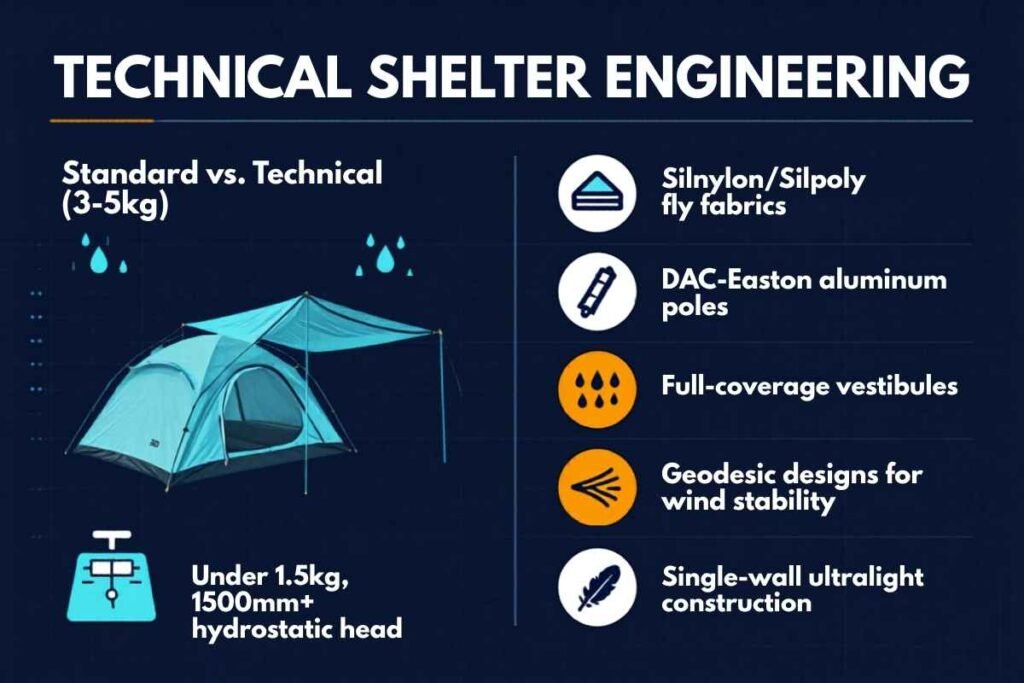
Where a standard camping tent might weigh 3–5 kg and be rated for three-season use, a technical shelter like an MSR Hubba Hubba or a Big Agnes Copper Spur tips the scales at under 1.5 kg while maintaining a 1,500 mm+ hydrostatic head rating.
Key technical features to look for in shelters
- Silnylon or silpoly fly fabrics are lighter and more water-resistant than standard polyester
- DAC or Easton aluminum poles have a stronger strength-to-weight ratio than fiberglass.
- Full-coverage vestibules for gear storage in wet weather
- Geodesic or semi-geodesic designs for wind stability above treeline
- Single-wall construction for ultralight applications (with condensation tradeoffs)
Sleep system
A technical sleeping bag is one of the most consequential gear decisions you’ll make.
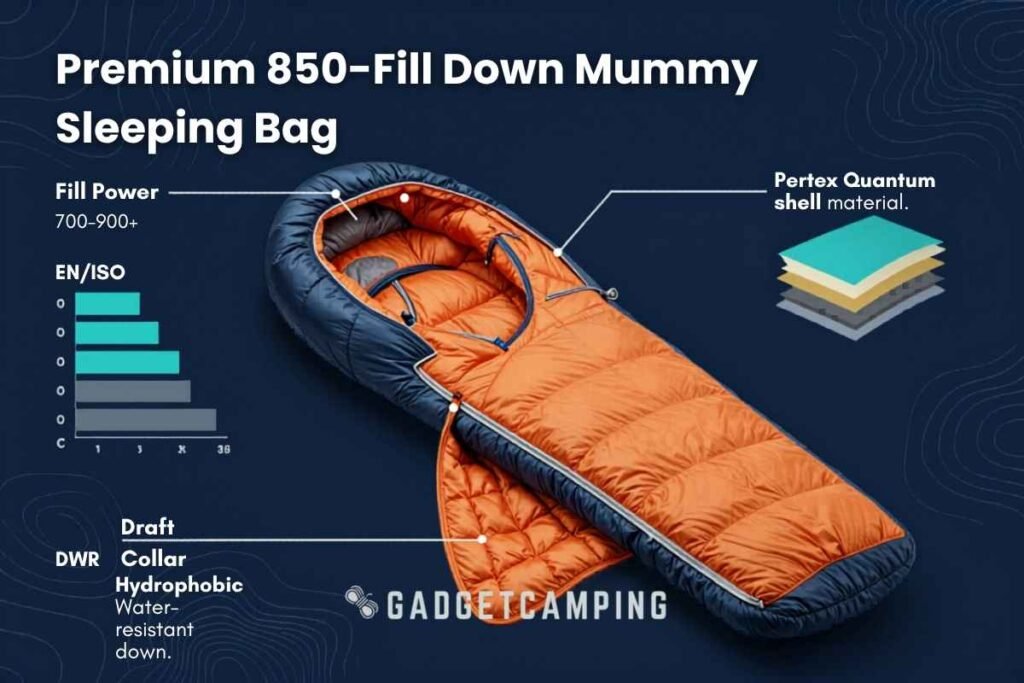
The difference between a 400-fill synthetic bag and an 850-fill hydrophobic down mummy bag isn’t just comfort in serious cold; it’s safety.
Technical sleeping bags and quilts are defined by:
- Fill power (700–900+ for premium down): higher fill power = warmer for less weight
- EN/ISO temperature ratings: standardized lab testing for limit and comfort temperatures
- Shell materials like Pertex Quantum for packability without sacrificing durability
- Water-resistant down treatments (DWR or hydrophobic coating) for wet conditions
- Draft collars, hood baffles, and zipper draft tubes to eliminate cold spots
Insider note: The EN comfort rating is the temperature at which an average woman sleeps comfortably. The EN limit rating applies to an average man. Most experienced campers add 5–10°C of buffer to whatever rating they’re targeting.
Backpack
A technical pack isn’t just a bag with straps, it’s a load-carrying system engineered to distribute weight efficiently across your hips and shoulders for hours or days on the trail.
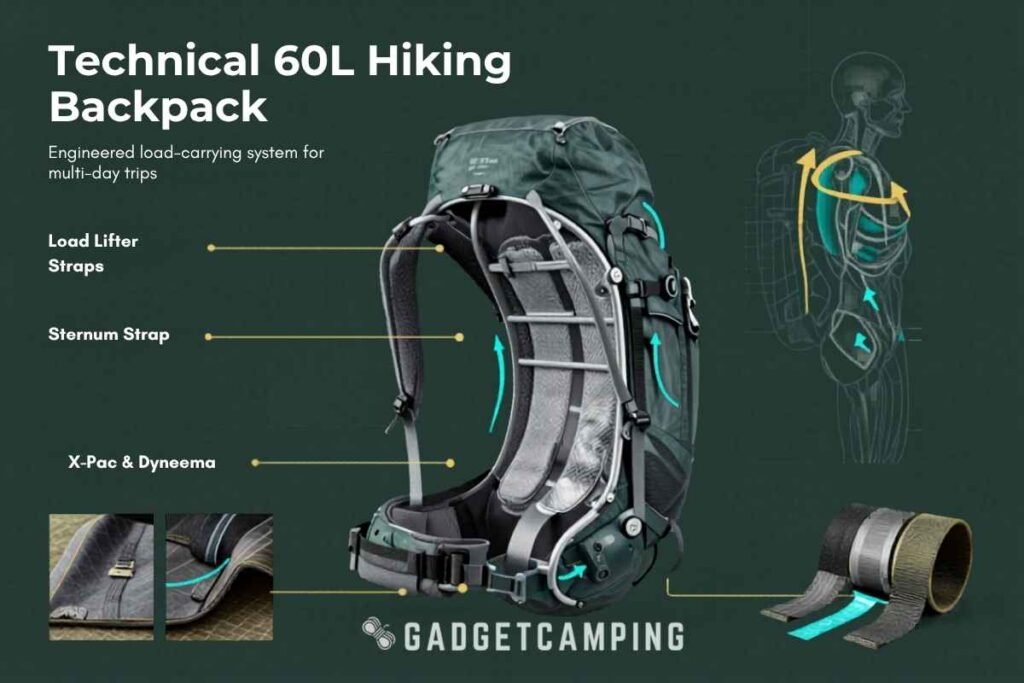
The difference shows up most on day three of a multi-day trip.
What separates technical packs from standard daypacks:
- Adjustable torso lengths and hip belt sizing for anatomical fit
- Internal frame stays (aluminum or carbon) for load transfer and structure
- Frameless ultralight options for sub-10 lb base weight builds
- Materials like X-Pac or Dyneema for weight savings with exceptional durability
- Load lifter straps, sternum straps, and load compression systems
Cooking and water
Technical stoves are optimized for specific conditions that consumer stoves struggle with: extreme cold, high altitude, or trips where fuel weight is a genuine constraint.
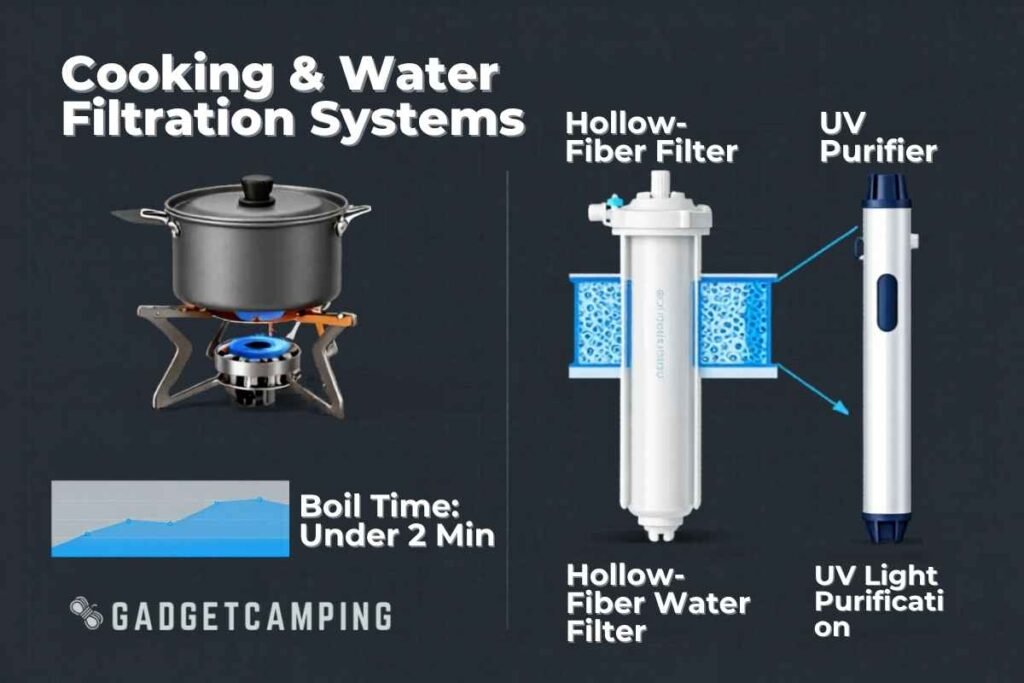
A Jetboil Flash boils 500 ml in under two minutes. An MSR WhisperLite Universal runs on white gas, kerosene, and unleaded fuel, critical for international expeditions where canisters aren’t available.
Water filtration becomes genuinely technical when you’re in areas with a high risk of contamination. Standard filters remove bacteria and protozoa.
Technical purifiers, UV devices like the SteriPen, or hollow-fiber filters like the Sawyer Squeeze also address viruses, which is essential for international travel and many remote regions.
Navigation tools
For serious backcountry travel, paper maps and a baseplate compass remain the most reliable navigation tools available; they don’t run out of battery.
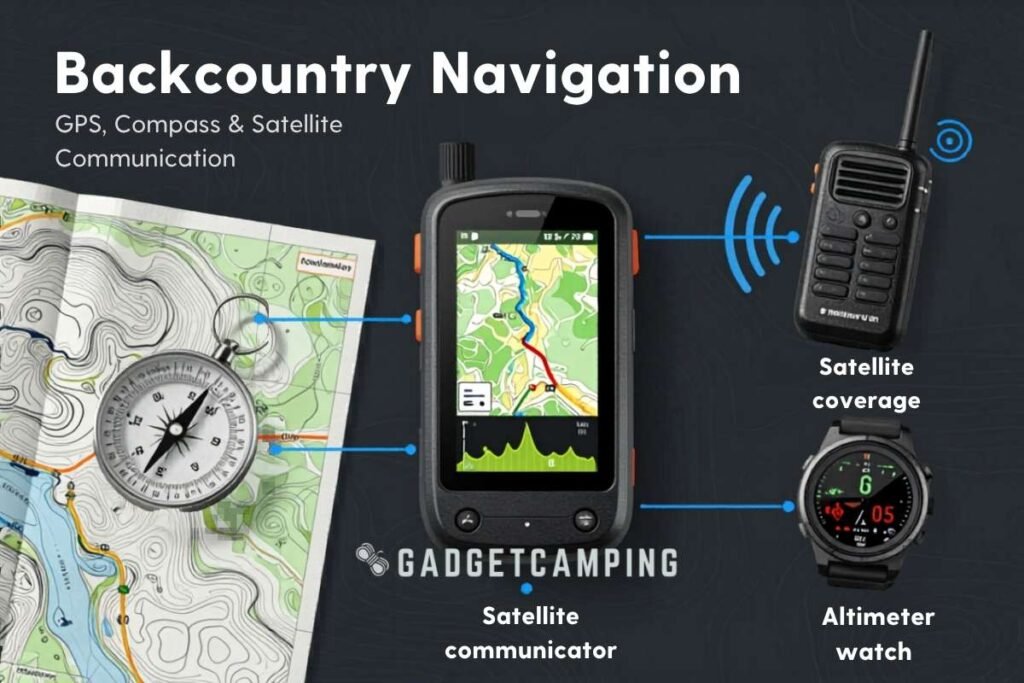
Technical navigation gear adds GPS devices with preloaded topo maps, two-way satellite communicators like the Garmin inReach for emergency messaging beyond cell coverage, and altimeter watches for real-time elevation tracking.
Clothing and layering
Technical apparel refers to performance clothing engineered for specific outdoor conditions.
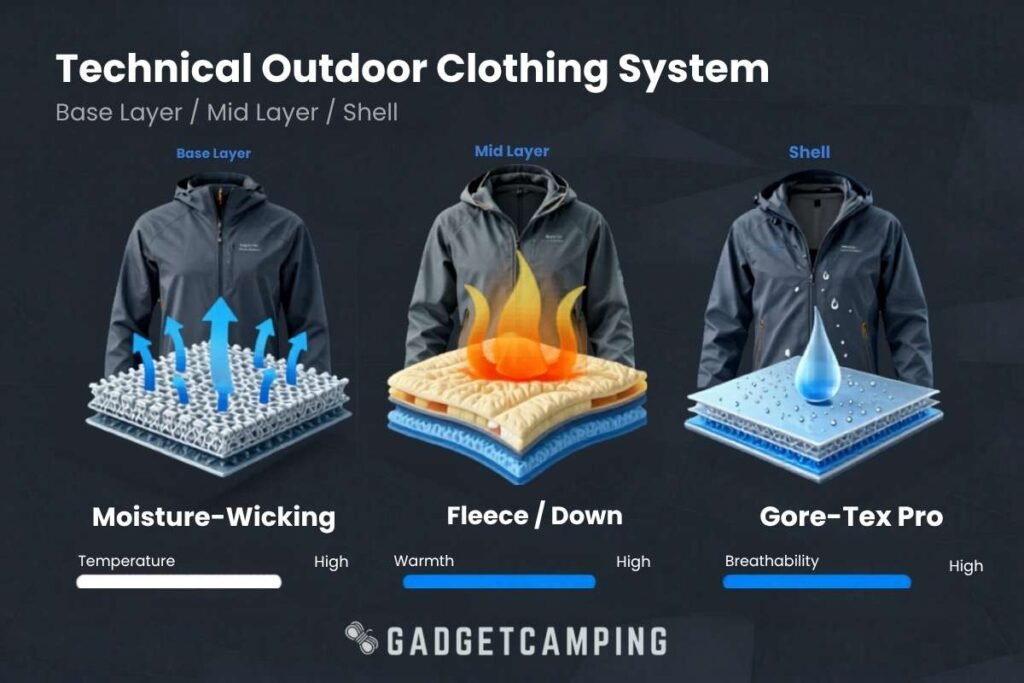
A technical jacket, for example, isn’t just weatherproof; it uses fabrics like Gore-Tex Pro, eVent, or Pertex Shield to achieve both waterproofing and breathability simultaneously, a tradeoff that regular waterproof jackets can’t manage.
A technical sweater (often called a midlayer) uses fleece or down insulation engineered to trap heat while allowing moisture to pass through, forming part of a layering system rather than functioning as a standalone garment.
The technical layering system base layer, mid layer, and shell are some of the most important concepts in camping and hiking.
Each layer has a specific job: moisture management, insulation, and weather protection.
Technical versions of each layer perform those jobs significantly better than standard alternatives in demanding conditions.
Who actually needs technical camping gear?
This is the question most gear guides skip, but it’s the most important one. Technical gear is not universally necessary.
Here’s how to think about whether you actually need it.
When regular gear is completely fine
You can absolutely stick with standard camping gear if you are
- Camping in mild, predictable three-season weather (spring through autumn in temperate climates)
- Taking day hikes with a base camp to return to each night
- New to camping and building skills before investing in a full kit
- Camping close to trailheads where weight isn’t a major factor
If this describes your camping style, technical gear will give you diminishing returns for a significantly higher price. Spend your money on experience instead.
When technical gear genuinely matters
Technical gear starts earning its cost when you are:
- Backpacking multi-day routes where pack weight directly affects how far you can travel
- Camping in harsh or unpredictable weather, alpine environments, winter conditions, exposed ridgelines
- Going above treeline or at high altitude, where standard tents and stoves underperform
- Thru-hiking long-distance trails like the PCT, CDT, or Appalachian Trail
- Travelling to remote areas where evacuation is difficult, and gear failure is a genuine risk
- Camping in wet climates where synthetic insulation and standard waterproofing aren’t enough
Rule of thumb: If your gear will be your only shelter, warmth source, or survival system in an environment where conditions can turn dangerous, technical gear is worth it. If you have a car, a campground, or an easy exit nearby, standard gear will do the job.
Is technical camping gear worth the price?
Technical camping gear is expensive; there’s no way around that. A premium ultralight tent can cost four to six times as much as a standard three-season tent.
A 900-fill-down sleeping bag might run to $500 or more. So is it worth it?
The answer depends on how often you use it and under what conditions. Technical gear is built to last. A well-maintained Osprey pack or MSR tent will still be performing at full capacity after 10–15 years of hard use.
Amortized over that lifetime, the cost-per-use often comes out lower than repeatedly replacing cheaper gear that wears out faster.
More importantly, technical gear can expand what’s possible for you as a camper. The ability to carry a 2 kg sleep system instead of a 4 kg one doesn’t just save your back; it changes which
routes you can attempt, how far you can go in a day, and how comfortable you are when you get there.
That said, buy technical gear incrementally. Start with the big three: tent, sleeping bag, and backpack, before optimizing everything else.
And always prioritize fit and function over brand names or spec sheets.
How to start building a technical camping kit
If you’re moving into technical camping for the first time, the most important thing is to resist buying everything at once. Build your kit in a deliberate order:
1. Start with the big three. The tent, sleeping bag, and backpack account for the majority of your pack weight and have the biggest impact on your comfort and safety. Get these right first.
2. Add a stove and water system. A lightweight canister stove and a reliable water filter are the next essentials. Choose based on your destinations a canister for three-season domestic trips, liquid fuel, or solid-fuel backup for winter and international travel.
3. Build your clothing system. A technical base layer, a midlayer fleece or down jacket, and a waterproof shell will handle the majority of conditions you’ll encounter.
4. Add navigation and safety gear. A paper topo map and baseplate compass are nonnegotiable for any backcountry travel. A GPS device or satellite communicator comes next for remote routes.
5. Optimize over time. As you log more miles and understand your specific needs, you’ll know exactly where to invest next. Don’t front-load upgrades before you’ve developed a sense of your priorities.
Frequently asked questions
What does ‘technical’ mean in outdoor gear?
In the outdoor industry, ‘technical’ refers to gear that is purpose-engineered for demanding conditions or performance-critical applications.
It typically means lighter weight, more advanced materials, greater weather resistance, and better performance under stress than standard consumer gear.
Is technical camping gear suitable for beginners?
Some technical gear makes sense for beginners, particularly lightweight backpacks and reliable water filters.
However, most beginners are better served by learning the basics with mid-range gear before investing in premium technical equipment. Skills matter more than gear at the start.
What are the big three of camping?
The ‘big three’ refers to the three heaviest and most expensive items in a backpacker’s kit: the tent (or shelter), the sleeping bag (or quilt), and the backpack.
Reducing weight in these three categories has the biggest impact on your overall pack weight.
What is a technical jacket?
A technical jacket is a waterproof, windproof outer layer made with performance fabrics like Gore-Tex, eVent, or Pertex Shield that combine weather protection with breathability.
Unlike standard waterproof jackets, technical jackets allow moisture vapor to escape while keeping rain and wind out, critical for sustained activity in wet conditions.
What is the difference between regular and technical camping gear?
Regular camping gear prioritizes comfort and affordability for mild, accessible camping. Technical camping gear prioritizes weight, weather resistance, durability, and packability for demanding backcountry conditions.
The tradeoff is cost: technical gear commands a significant price premium that is worthwhile for frequent, serious, or remote campers but unnecessary for casual use.
What to wear for camping?
For technical camping, a layering system works best: a moisture-wicking base layer against your skin, an insulating mid-layer (fleece or down), and a waterproof, breathable shell jacket.
Avoid cotton in all layers; it absorbs moisture and loses insulating properties when wet. Merino wool and synthetic fabrics are the standard for technical base layers.
Related articles: Technical Camping Gear Checklist | How to Choose Technical Camping Gear | Common Technical Camping Gear Mistakes to Avoid | Technical Camping Gear for High Altitude