
Why Camping Solar Panels Became Off‑Grid Life Support in 2026
Modern camping depends on electricity. Refrigerators preserve food for 5–10 days, CPAP machines protect health every night, and laptops keep digital nomads earning income far from civilization.
Camping solar panels no longer act as convenience chargers; they function as off‑grid life support systems.
Durability and portability now define value. Choose panels that survive dust storms, alpine rain, and repeated folding if you camp year‑round.
Prioritize weight efficiency if you move camp frequently. In 2026, IP durability ratings and weight‑to‑watt ratio outweigh brand names and inflated wattage claims.
This guide explains how to choose the best solar panels for camping, compares the top models for 2026, and shows exactly how much power you can expect in real conditions.
What Actually Matters When Buying Camping Solar Panels?
Why Cell Efficiency Determines Real‑World Output
High efficiency converts limited sunlight into usable electricity. Accept 23% efficiency or higher if you buy camping solar panels in 2026. Lower efficiency panels waste pack weight and setup space.
Monocrystalline cells dominate portable solar panels for camping because they:
- Produce more power per square inch
- Maintain voltage in high heat above 90°F (32°C)
- Recover faster after cloud cover
Choose monocrystalline panels if reliability matters. Polycrystalline panels reduce cost but increase weight and suffer larger performance drops in heat and partial shade.
Verdict: Buy monocrystalline only.
How IP Ratings Separate Gear from Gadgets
Durability determines lifespan. IP (Ingress Protection) ratings measure resistance to dust and water intrusion.
- IP67: Dust‑tight and submersible up to 1 meter for 30 minutes
- IP68: Dust‑tight and rated for continuous immersion (manufacturer‑defined depth)
Select IP67 minimum for camping. IP68 matters for overlanding, paddling, or monsoon climates.
Avoid panels without published IP ratings. Manufacturers that skip ratings often skip proper sealing.
Why Weight‑to‑Watt Ratio Became the New Standard
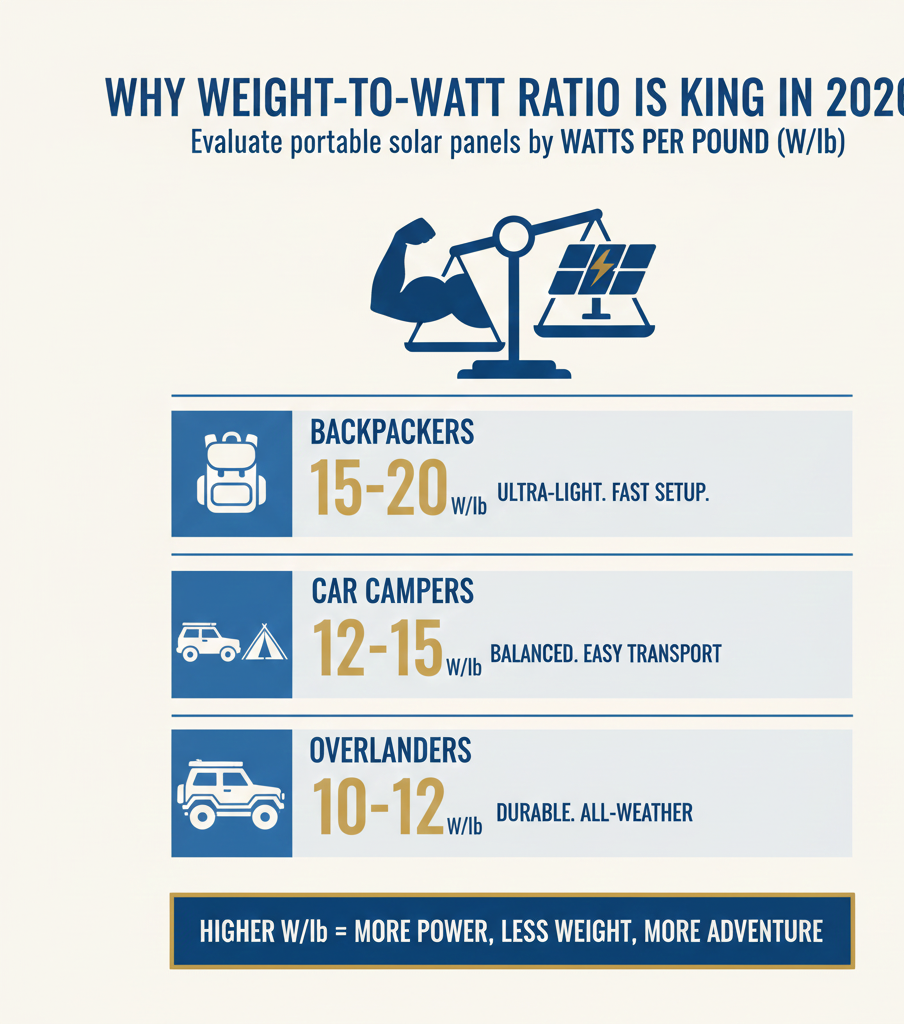
Weight limits mobility. Evaluate portable solar panels using watts per pound (W/lb) instead of peak wattage.
- Backpackers: 15–20 W/lb
- Car campers: 12–15 W/lb
- Overlanders: 10–12 W/lb (durability trade‑off)
Higher ratios mean faster setup, easier transport, and less fatigue over multi‑day trips.
ETFE vs PET: The Coating That Decides Lifespan
Panel coatings protect cells from UV radiation, abrasion, and heat cycling.
- ETFE (Ethylene Tetrafluoroethylene)
- Tolerates 150°C surface temperatures
- Resists scratching and delamination
- Lasts 3–5× longer outdoors
- PET (Polyethylene Terephthalate)
- Degrades under sustained heat
- Micro‑cracks after repeated folding
- Yellows under UV exposure
Choose ETFE‑laminated foldable solar panels if you expect more than one season of use.
Best Solar Panels for Camping in 2026
Best Overall Camping Solar Panel: Jackery SolarSaga 200
Best for most campers who want reliability without complexity.
- Output: 200W
- Weight: 17.9 lb
- Efficiency: ~23.5%
- Coating: ETFE
- IP Rating: IP67
The SolarSaga 200 delivers consistent real‑world output of 140–160W in clear conditions. Integrated kickstands optimize angle automatically, and setup takes under one minute.
Choose this panel if you power:
- 12V fridges (45–60W)
- CPAP machines (30–60W)
- Laptops, drones, and Starlink Mini systems
Best Lightweight Solar Panels for Backpacking & Minimalists
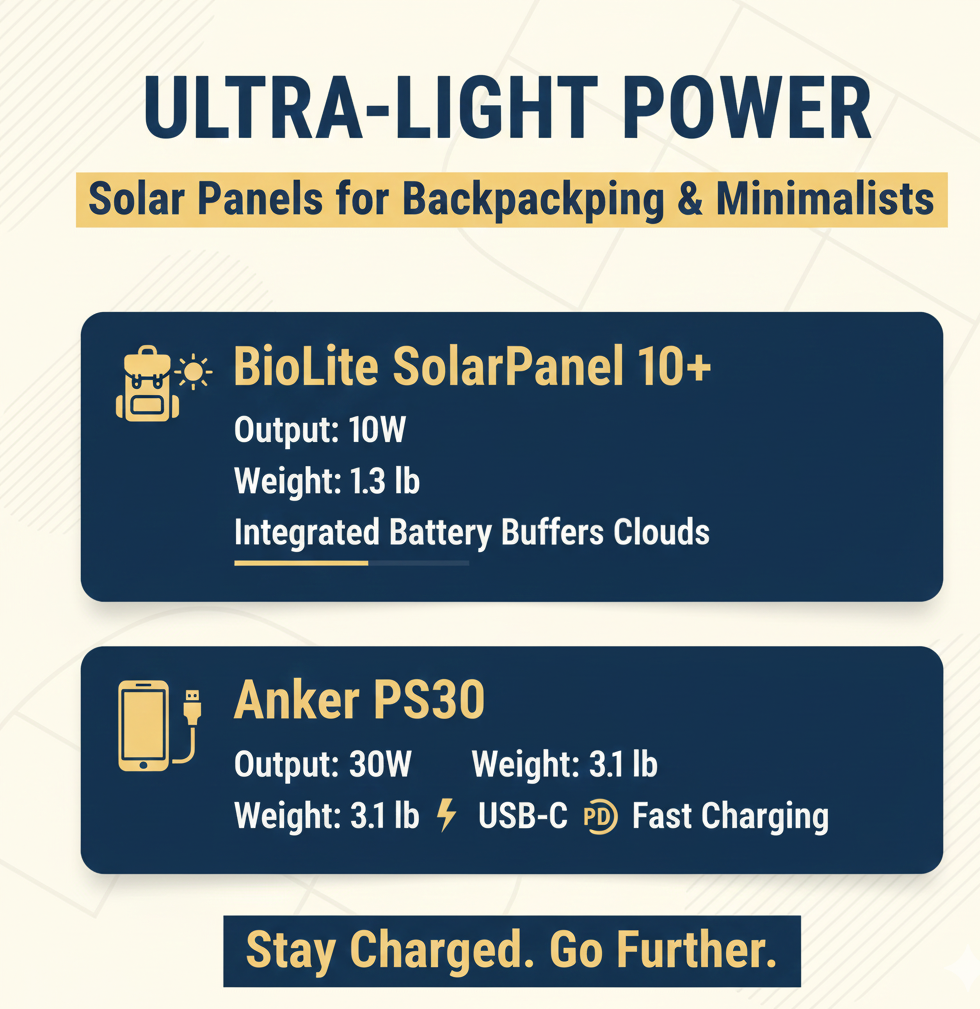
Best for hikers who value weight savings over raw output.
BioLite SolarPanel 10+
- Output: 10W
- Weight: 1.3 lb
- Integrated battery buffers clouds
Anker PS30
- Output: 30W
- Weight: 3.1 lb
- USB‑C PD support
These panels charge phones, GPS units, headlamps, and small power banks efficiently during daylight stops.
Most Durable Solar Panels for Harsh Environments: Bluetti PV Series
Best for desert heat, coastal humidity, and extended exposure.
- Output range: 120W–350W
- Coating: Reinforced ETFE
- IP Rating: IP67+
- Watts per pound: ~11–13
Bluetti panels resist delamination and stitching failure better than most competitors. Choose them if your trips include sand, salt air, and weeks of outdoor deployment.
Best Solar Panels for Large Power Stations: EcoFlow 400W
Best for overlanders and full‑time off‑grid setups.
- Output: 400W
- Weight: 35 lb
- Efficiency: ~23%
- Connector: MC4
Expect 280–320W sustained output under ideal sun. Pair with EcoFlow Delta Pro or Bluetti AC500 systems for extended autonomy.
Comparison Table: Solar Panels That Matter in the Field
Compatibility Guide: Prevent Expensive Mistakes
Connector Types Explained
Match your panel to your power station:
- MC4: Industry standard (EcoFlow, Bluetti)
- XT60: Portable battery packs
- Anderson Powerpole: Vehicle‑based systems
- DC7909 / DC5521: Small generators and battery boxes
Adapters work, but native connectors reduce voltage loss.
Why MPPT Charge Controllers Matter
MPPT (Maximum Power Point Tracking) controllers extract 15–30% more energy than PWM controllers by adjusting voltage dynamically. Most modern power stations include MPPT internally.
Confirm MPPT support if you build a DIY system.
Real‑World Performance: What to Expect Outside the Lab
The 80% Rule
Expect 70–85% of rated output in ideal sun. A 200W panel typically delivers 140–160W.
Output varies with:
- Sun angle
- Panel temperature
- Cable length
Oversize your system to avoid shortages.
Partial Shading and Bypass Diodes
Shade one cell and cheap panels collapse. Quality camping solar panels use bypass diodes to isolate shaded sections, preserving 60–80% output instead of total failure.
Weather Impact Chart: Solar Output by Conditions
- Clear sky: 100%
- Partly cloudy: 50–70%
- Overcast: 10–25%
- Rain: 5–15%
Campers in forests or coastal regions should oversize capacity by 30–50%.
Battery Sizing: How Much Solar Do You Actually Need?
Daily power example:
- 12V fridge: 600 Wh
- CPAP: 400 Wh
- Laptop + phone: 200 Wh
Total: 1,200 Wh/day
Plan 1.5× daily consumption in panel capacity to maintain battery charge under imperfect conditions.
Maintenance: Make Panels Last 5+ Years
Clean panels every 2–4 weeks during continuous use.
Safe cleaning protocol:
- Rinse with distilled or deionized water
- Wipe using microfiber cloth only
- Avoid detergents and stiff brushes
This prevents micro‑scratches that permanently reduce efficiency.
Common Buying Mistakes to Avoid
- Trusting peak wattage claims without real‑world context
- Buying PET‑coated panels for multi‑season use
- Ignoring IP ratings
- Undersizing systems for cloudy climates
- Using long, thin cables that cause voltage loss
Final Verdict: Best Solar Panels for Camping in 2026
Choose camping solar panels that prioritize durability, efficiency, and portability.
- Buy Jackery SolarSaga 200 for balanced performance
- Choose Bluetti PV Series for harsh environments
- Select EcoFlow 400W for long‑term overlanding
Power independence defines modern camping. Choose once, size correctly, and stay charged wherever the trail ends.
CampSolar Explorer
Smart Sizing Calculator for 2026 Gear
Frequently Asked Questions (FAQ)
What size solar panel do I need for camping?
Choose panel capacity based on daily watt-hour consumption. Most car campers need 200–400W if they run a fridge and charge electronics daily. Full-time overlanders often require 600W or more to offset cloudy days.
Are camping solar panels waterproof?
Camping solar panels are water-resistant, not indestructible. Select IP67-rated panels to withstand rain, dust, and brief submersion. Avoid unrated panels for multi-day outdoor use.
Do portable solar panels work on cloudy days?
Portable solar panels still generate power under clouds, but output drops sharply. Expect 50–70% output in partial clouds and 10–25% under full overcast.
Can I charge a power station directly from solar panels?
Yes. Most modern power stations accept direct solar input through MC4, XT60, or DC connectors and include internal MPPT controllers for efficiency.
How long do foldable solar panels last?
ETFE-coated foldable solar panels typically last 5–10 years with proper care. PET-coated panels often degrade after 1–3 seasons of heavy use.
Conversion-Focused Buyer Guidance
Choose This Panel If You Want Zero Guesswork
- Jackery SolarSaga 200: Best balance of durability, efficiency, and portability
- Bluetti PV Series: Best choice for extreme heat, dust, and humidity
- EcoFlow 400W: Best for long-term off-grid and vehicle-based systems
Avoid undersized panels if you rely on refrigeration or medical devices. Oversizing by 30–50% prevents power anxiety.